WR News Writer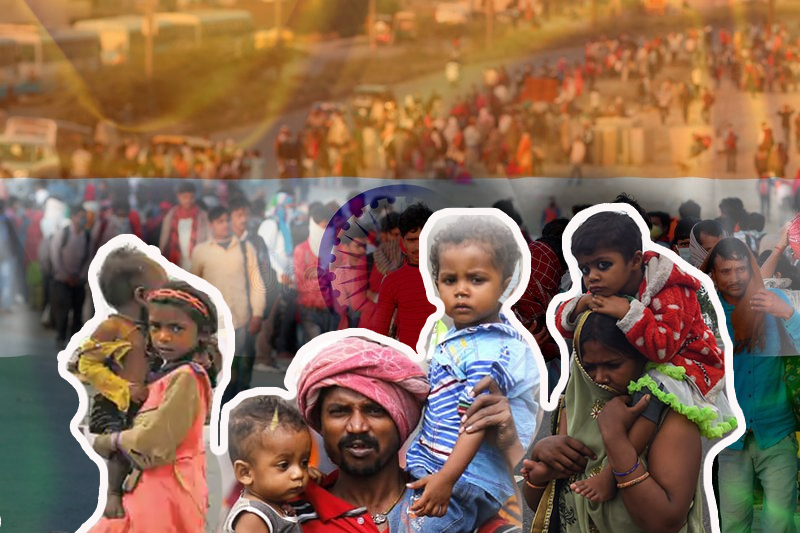
backward migration may harm urban economy
 India – The National Statistical Office (NSO) revealed the long-awaited official statistics on migration in its Fourth Periodic Labour Force Survey (PLFS) data, which was issued on June 14.
The “Migration in India 2020-21” report, published by the NSO, contains information on Covid/lockdown-induced migration. It is based on a sample survey of 1,00,344 homes, 4,10,818 people, of whom 1,13,998 were migrants. The 64th Round of the NSSO on Migration (2007–2008) and Census 2011 were the most recent migration datasets that were previously accessible.
The All India Survey of Migrant Workers was initiated by the Labour Bureau of the Ministry of Labour and Employment in 2020–21, but the data and report have not yet been made public.
The Azim Premji University and other private institutions have undertaken surveys on migration and lockdown. Prior to the current survey, very little recent official data on migration, migrant workers, and reverse migrant workers was available.
According to the NSO, a migrant is a person whose “present place of enumeration” (PoE) differs from his or her usual place of residence (UPR). UPR refers to the location (village/town) where a person has resided continuously for at least six months or intends to continue to reside continuously for at least six months.
If a person stays at various locations for at least six months, they are eligible for many UPRs throughout their lifetime.
According to the research, the country’s migration rate is 28.9%. The percentage of migrants in the entire population is known as the migration rate. Migration may occur from rural to rural, from urban to urban, from urban to rural, or from urban to urban.
Additionally, classification of migrants according to gender and educational attainment yields intriguing findings. Male migration is substantially lower (18.8%) than female migration (81.1%), with “marriage” being the primary factor.
The highest percentage of migrants across all educational levels was found to be illiterates (33%) followed by primary educated (19%), secondary and senior secondary (18%), middle (17%), and graduate and above (11%) populations, indicating that migration was more common among the illiterate and less educated, as is expected.
Related Posts






Lockdown and migration
When the first-ever lockdown was implemented on March 24, 2020, to contain the Covid-19 outbreak, a sizable number of migrants endured a terrifying period.
Migrant workers were among the most at risk for malnutrition and unemployment among the population that were already at risk.
They experienced financial hardships and psychological trauma while stranded in other States and major cities without employment or money. In the absence of official statistics, much has been stated about the misery of migrants and reverse migration as a result of lockdown.
This PLFS data, which was gathered between July 2020 and June 2021, provides important statistics on the effects of lockdown on migrants using a cut-off point of “March 2020”. According to the data, 3.14 percent of all migrants in India (or 28.9 percent of the population) left after “March 2020.” The unit level statistics of PLFS also revealed that during 2020–21, the proportion of “reverse migrants” or returned migrants was predicted to be 11.1% of all migrants.
The returning migrants are people who relocated from their most recent UPR to their prior UPR (where they had previously resided). However, beyond the cutoff date of March 2020, this reverse migration was shown to be as high as 53%.
The primary causes of Covid-induced migration beyond “March 2020” include job loss/unit closure/lack of employment possibilities (19.35%), health (14%), parent/earning family member migration, etc.
On the other hand, the urban economy is struggling with a lack of trained and unskilled labor, particularly in the secondary sector; this could have an impact on industrial production.
Husain is an assistant professor of economics at Galgotias University, while Shrivastav is an assistant director at the National Institute of Labour Economics Research & Development (under NITI Aayog). Views stated here are your own.