abi sri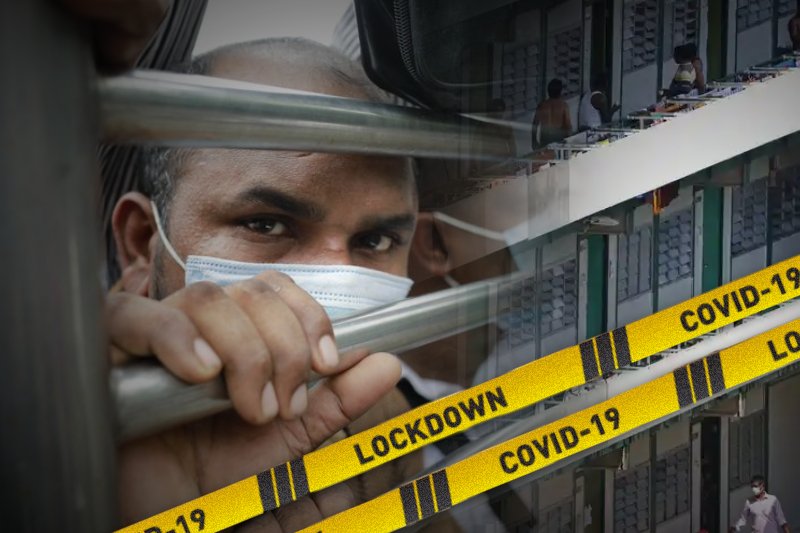
Migrant workers suffer in Singapore’s concealed lockdown
 Singapore – The men who keep Singapore running spend a weekday evening enclosed by a 2-metre-high fence at the Migrant Workers’ Centre Recreation Club, roughly 20 kilometers west of the city-core state’s business district.
Inside, vending machines dispense face masks and food vendors provide halal food to south Asian laborers who sip beers on plastic chairs across a huge concrete courtyard.
More than two years after Singapore’s first Covid-19 lockdown, locations like these, one of eight so-called leisure centres on the island’s outskirts, are the only places where tens of thousands of workers are able to spend time outside their homes.
“A Singapore resident can go wherever,” said Dhanu, an Indian technician who stays in a hostel near the recreation center with other foreign employees. “That’s not right… It’s a form of discrimination.”
In April, the Singapore government announced that it had withdrawn practically all of the remaining Covid restrictions, including those on travel and nightclubs. Businesses have praised the city-loosening state’s of rules, which has enticed high-earning professionals to relocate from more restrictive areas like Hong Kong.
Despite high immunization rates, many of the island’s lowest workers’ freedoms are severely restricted.
On weekdays, just 25,000 of the roughly 280,000 workers who live in dorms are allowed to leave the recreation centers or their workplaces — and only if they tell officials where they are going and limit their trips to eight hours. On weekends, 50,000 people are permitted to go.
Other epidemic tactics, according to campaigners, are still being used by the government to restrict migrant employees.
Related Posts



“The employees are still being held hostage,” said Jolovan Wham, a former director of the Humanitarian Organization for Migration Economics, a Singapore-based support group. “However, they are permitted to come out to work.” As a result, people see them, and it may give the sense that they are welcome in the community.”
Work permit holders in Singapore, who mainly come from poorer Asian nations to conduct domestic and manual labor, are the city-economic state’s backbone. There were around 849,700 work permit holders at the end of last year, compared to only 161,700 foreign professionals and a native population of about 3.5 million.
But they’ve been suffering in the shadows for a long time. Their relationships with locals are more restricted than those of higher-paid foreigners, as they live in concrete blocks far from the city’s glass apartment towers and work long hours at construction sites or shipyards. Even marrying or starting a family with a Singapore citizen requires official approval.
Covid-19, a virus that spread quickly through crowded dormitories, brought their suffering to public attention two years ago. Hundreds of foreign employees were infected every day by late April 2020, with Singapore reporting the world’s third-highest number of infections per capita.
The government retaliated forcefully, placing laborers in dorms with as many as 200 shared bathing facilities and as many as a dozen men crammed into one room.
Authorities agreed to strengthening standards after frequent complaints of attempted suicides by workers kept in such situations. The number of males in each room will be limited to 12, with each individual having a minimum space of 4.2 square meters, according to two new sites announced in September.
The new buildings were “superior in certain aspects,” according to Debbie Fordyce, president of the TWC2 support organization. She expressed concern, however, that workers were being relocated from regular living to dormitories, where surveillance had grown “far more stringent.”
The government removed the requirement that Singaporeans use a contact tracking app to check-in at most venues in April. Migrants must still register twice a day in their dormitory rooms, with employers able to track their movements using a second app called DormWatch.
“It became easier to limit people,” Fordyce added, recalling a recent incident in which dormitory security initially prohibited a man from visiting the hospital without his employer’s authorization.
According to the government, at least 98 percent of workers living in dorms are properly vaccinated against Covid. However, Lawrence Wong, Singapore’s prime minister-in-waiting and co-chair of the Covid task team, has justified the limits, claiming that they protect migrants in statements published by the local press.