
 The Workers Rights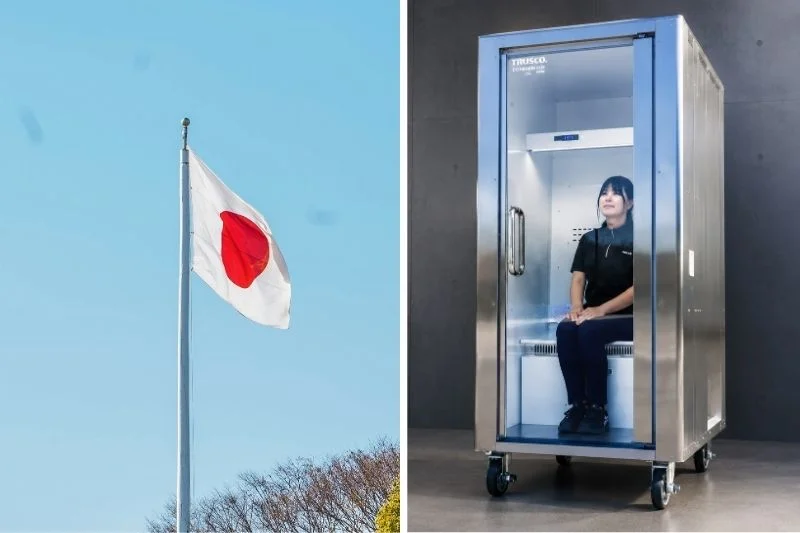
Japan’s human refrigerator, a walk-in cooling booth to rapidly cool the body in five minutes, is getting lots of attention around the world. It’s designed for construction or factory workers who are suffering from extreme heat during the summer, and it’s a snapshot of a rapidly changing landscape of heat protection in the workplace. However, this is only the beginning of many more they could invent.
The increasing duration and severity of heatwaves across the globe are driving industries to take proactive steps in safeguarding their workforce, from wearing smart clothing to enacting AI-driven cooling systems. Extreme heat workplace safety is on the horizon sooner than most realise.
Quick Facts
| Fact | Detail |
| What is it? | A single-person walk-in cooling booth |
| Developer | TRUSCO Nakayama Corporation is a Japanese industrial supplier. |
| Cooling time | Each session 5–10 minutes (maximum of 20 minutes) |
| Internal temp | Ambient ~15°C; air jets ~5°C |
| Target users | Anyone working on site, including construction workers, factory workers, warehouse workers, etc. |
| Power supply | Standard 100-volt; portable and has built-in casters |
| Inspired by | Technology of the vending machine of frozen food. Frozen Food Vending Machine Refrigeration Technology. |
What exactly is the Japan Human Refrigerator?
The Japan human refrigerator, as it is officially known, the Do Reimon Box, is a stainless-steel single-person cooling cab for the employees to step into, sit, and close the door for a quick recuperation during breaks. The powerful jets of air provide a cooling effect around the body, especially on the neck, head and back, which are the primary heat-regulation areas—cooling the user down much more quickly than normal air cooling could.
Portable, with no permanent installation needed, it can be rolled directly onto the construction site, factory floor or warehouse. The product is one of the most functional workplace cooling products to appear in recent years, and marks a new way of thinking about occupational heat stress by the employer.
Why Worker Heat Safety Can’t Wait
Every year, thousands of workers are killed and hospitalised by occupational heat stress. Heatstroke is one of the major occupational health problems in Japan during the summer because of excessive heat. Workers on construction sites, road crews and logistics personnel frequently endure situations that challenge the human body in extremely dangerous ways.
With temperatures often reaching 35°C, it is not enough to simply remind people of the need to take water bottles and shade breaks at work anymore; engineered solutions are needed. This is where the Japan human refrigerator comes into play – providing a quick and effective means for workers to reach a normal core temperature before returning to the heat.
Beyond the Booth: A Look at Emerging Heat Safety Technologies
The Do Reimon Box is impressive, but it’s one component of a much larger one. Let’s look at some of the innovative ways that industrial cooling is changing the approach to employee heat protection worldwide:
| Technology | How It Works | Best For |
| Japan Human Refrigerator (Do Reimon Box) | A walk-in booth with targeted cold air jets. | Construction sites, factories |
| Wearable cooling vests | The body heat absorbers are called phase-change materials. | Outdoor field workers |
| Smart heat stress monitors | Core temp + HR sensors to wear | High-risk industrial jobs |
| Misting systems + fans | Open work areas: evaporative cooling. | Warehouses, outdoor sites |
| AI-managed HVAC | Forecasting the cooling needs of workers by looking at their schedules. | Huge factories and logistics centres |
| Cooling neck wraps | Carotid artery ice-pack inserts | Short-duration outdoor tasks |
One area of technology that has shown great potential is wearable cooling. In the construction and agriculture industries, lightweight vests and smart bands are now being tested, providing personal protection for individual workers when shared cooling equipment isn’t on the job site.
What Regulations Say—and Where They’re Heading
In the last ten years, the regulations for heat safety have been tightened significantly in Japan, and it has become a legal requirement for employers of high-risk industries to ensure that cooling facilities, hydration stations, and measures for heat illness response are provided. Partly, the push for innovations such as the Japan human refrigerator has been regulatory and partly due to the economic losses suffered by the lost working days due to heat illness.
Other countries are following suit. Workplace policies to counter heat waves are being implemented throughout the EU, US and parts of the Middle East, including mandatory rest breaks, wet bulb temperature limits and employer liability. Climbing to the top of the corporate ladder is no longer about being a “good guy”; it’s about being required by law.
More Japan Work Updates Await
Planning To Work In Japan?
Check out the latest immigration rule changes.
Is Overtime Culture Returning Again?
Find out why workplace expectations are shifting.
Could Overtime Cost Your Health?
Uncover the latest karōshi compensation trends.
Are Office Dress Rules Changing?
See how labor shortages are reshaping workplaces.
Can You Trust Japan’s Pension?
Browse the latest worker pension reforms.
The Bigger Picture: Future of Workplace Safety
In terms of logic, the Japanese human refrigerator makes perfect sense: allow workers to quickly and efficiently cool down from heat exposure before it becomes hazardous. By shifting from a passive form of heat stress management to an active one, workplaces that invest in their cooling infrastructure will be better equipped to keep employees on board, lower rates of illness and absenteeism, and adhere to increasingly stringent regulations.
In the years to come, the factory worker, wearable technology, and environmental sensors will all come together in order to create what the experts term a “layered cooling strategy” in order to ensure that we don’t have to be dependent on one technology. The future of heat protection in the workplace post-2026 is a future where heat protection is part of the job process, rather than being an afterthought.
Japan was the first to introduce its walk-in cooling booth. Everyone else is gazing in awe—and taking notes.
FAQs
What is the Japanese human refrigerator?
A portable walk-in cooling booth, developed by TRUSCO Nakayama Corporation, is called Do Reimon Box. It is a method of cooling a worker’s body in 5–10 minutes through cold air jets.
Who is the Japanese human refrigerator designed for?
Primarily construction workers, factory workers, warehouse workers and other workers who work outdoors or in an industrial setting and are exposed to high temperatures while working.
Is it safe to use the Japan human refrigerator daily?
Yes. Sessions are automatically limited to 20 minutes to avoid overcooling and are intended for repeated daily usage at allotted times for work breaks.
Can the Japan human refrigerator treat heatstroke?
No. It isn’t a medical device. It’s a preventative tool to help workers recover from heat stress before it gets serious. Hospitals are still needed for heat stroke victims.






Recent Comments