
 The Workers Rights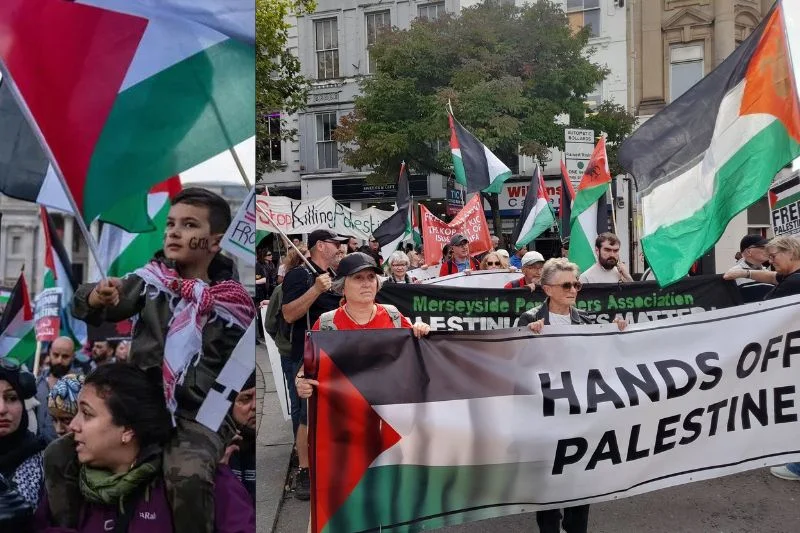
The UK’s massive pro-Palestine rallies have been subjected to a renewed focus on the organisational structure behind them, with a new report claiming that the events are more aptly described as a ‘coordinated network’ than as a succession of completely organic grassroots campaigns.
NGO Monitor’s July 2026 report, Imported Influence: Foreign Funding, Regulatory Gaps and Extremist Connections in the Infrastructure of British Protests After October 7, charts 40 examples of protests and mobilisation since October 2023 in Britain. It lists 6 groups that it sees as recurring organisations, such as the Muslim Association of Britain (MAB), Stop the War Coalition, the Palestinian Forum in Britain, Palestine Solidarity Campaign and the Campaign for Nuclear Disarmament.
But the report’s findings are NGO Monitor’s analysis and allegations, rather than a finding of the UK government. This is significant when evaluating allegations of political influence, foreign funding, or extremist involvement.
MAB’s Position in the Protest Ecosystem
MAB is one of six organisations that constantly feature in large-scale protests related to the events of October 7, according to NGO Monitor’s mapping. These groups make up the heart of a much wider network of dozens of organisations, campaigners and funding sources, the report says.
MAB’s importance is also linked with broader issues of the Muslim Brotherhood. On past occasions, the UK government has had a formal review of the Muslim Brotherhood, which included a study of its ideology, activities, organisation and impact on the interests of the UK. An evaluation was requested in 2014, and the key results were reported in 2015.
The mere fact that the government has historically looked closely at MAB does not make it a part of the Muslim Brotherhood or necessarily mean that all of the other organisations involved in pro-Palestine demonstrations align themselves with that ideology. Instead, it’s an update on why the organisational relationships of MAB remain a political and regulatory topic.
MAB’s charitable activities are also separately reported. The MAB Charitable Trust is a registered charitable organisation with a primary objective of charitable work, including religious work, education, poverty relief and humanitarian work. The next year it has records of income of around £874,910 for the financial year to April 2025.
Funding and Organisational Links Under Scrutiny
The NGO report by Monitor is not just about who is involved in demonstrations, but who is planning, funding and organising them.
Of the 40 organisations considered, 10 are charities, eight are companies, nine have a hybrid structure, and 13 do not have a legal structure in the UK to regulate them but raise public money. It also claims that millions of pounds are entering the broader protest movement via donations, memberships, foundations, international funding networks and cryptocurrency.
Other claims by NGO Monitor are that 19 of the sample of NGOs are funded directly from the UK government, or indirectly via schemes like Gift Aid, and other NGOs have been funded by governments and institutions abroad with links to the UK government. These claims should be verified on an organisation-by-organisation basis, and being funded by public and/or charitable sources does not constitute evidence of extremist activities.
However, the report contends that the mix between the political campaigning and the protest coordination and complex organisational structures raises questions of transparency for regulators.
Extremism Allegations Require Careful Distinction
A key point during the debate is the possible connections between some of the protest-network organisations and parties that are listed as or described as extremist or terrorist organisations.
There are at least 11 organisations in its sample that are connected with or have had officials who have interacted with organisations such as Hamas, Hezbollah, the Popular Front for the Liberation of Palestine, the Islamic Revolutionary Guard Corps of Iran or the Muslim Brotherhood, NGO Monitor has said.
Those are assertions of NGO Monitor, and should not be viewed as confirmation of the alleged MAB and/or pro-Palestine support for those organisations.
The difference is significant as the British protest scene has many organisations with very different structures, aims and attitudes. Shared demonstration/cooperation does not imply shared ideology, funding or operational control.
Its response to extremism in connection with protest has, however, become more interventionist in the UK. The Court of Appeal heard the case of Palestine Action’s legal challenge against the proscription by the Government under the Terrorism Act 2000 in June 2026. The issue in the case was whether the proscription decision should be upheld after being quashed by a lower court.
What Happens Next for MAB and Protest Networks?
The main question now is not just participation in protests, but whether or not they were done transparently.
NGO Monitor calls for improved disclosure of foreign funding, increased transparency for hybrid organisations, tighter guidelines on political campaigning by charities and enhanced regulation of cryptocurrency fundraisers. It also requests the governments and/or parliament to consider the financing and coordination of the protest networks.
The dichotomy between what MAB does and claims to do and what it is accused of doing in terms of political or ideological interests will thus remain key for MAB. Its registered charitable structure and finances are suggested by the charity records, and its position within its broader protest ecosystem is also analysed by NGO Monitor.
The real question is whether Britain has a pro-Palestine protest movement, which it clearly has, or how clear its organisational networks are, where its money is being raised and whether the regulators have the power to differentiate between legitimate political campaigning and activity carried out by illegal or extremist actors.
Global Worker Rights Issues You Should Know
Who Pays Rising H-1B Extension Costs?
Check out what workers can do if employers refuse payment.
How Do Malaysian Workers Navigate Singapore?
Find the key housing, economic and retirement challenges.
Could UK Bosses Really Face Jail?
Uncover what the illegal hiring crackdown means for workers.
Why Are Ceuta Migrants Returning?
Browse the food, safety and migration pressures driving returns.
Can Europe Solve Its Labour Shortage?
See why migration controls clash with growing worker demand.




Recent Comments