
 kritika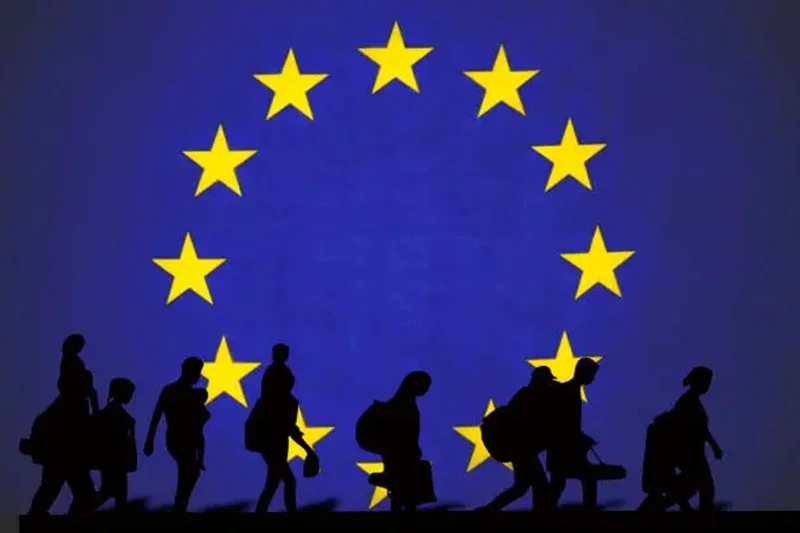
2026 is a year of tension at the heart of European politics, and no press conference can mask it. The EU, on the other hand, is boasting that it has “more control” over irregular migration than in decades. On the other hand, hospitals in Europe find they are unable to accept patients, farms are abandoning crops to go bad, and projects are set back years because of a lack of workers. These are both true, and the leaders of the continent aren’t truthful enough about their head-on collision course.
The contradiction has been clearly illustrated in the crisis of Ceuta this summer. In just a few hours, over 70,000 people entered the North African enclave of Spain, sparking emergency measures at the border, political speeches by Rome and a five-point enforcement plan by Brussels. The EU Migration Policy 2026 is now more of a security document than a second-best labour market document. Such a list of priorities might be politically convenient. Socially, it’s becoming more and more impossible and economically, it’s becoming economically unsustainable.
The Control Narrative Is Working — Politically
There’s one thing to be said for the EU: it has developed a more unified border management system than it did in 2015. The reformed Common European Asylum System has been shown to be effective, the screening process has been accelerated, and Frontex operations have been increased. There have been fewer arrivals than usual. There has been a decrease in asylum applications. Migration Commissioner Magnus Brunner has something to point to in terms of the real institutional progress made.
However, the word “control” for EU policy on migration is a less robust concept than it is made out to be. Morocco played a crucial role when the Ceuta situation calmed down, cooperating in large part to ease the crisis. The decision to put in place travel restrictions on arrivals from Spain, which analysts described as “political theatre” rather than an operational need, is a classic case of how quickly Europe’s migration control breaks down into member-state point-scoring. It seems that the EU’s border resilience is far from assured and relies on the cooperation and goodwill of partners outside the EU and on intra-EU political unity and cohesion that quickly fades when elections are on the horizon.
The one thing that is lost is a very simple question: control migration for what purpose?
Europe’s Labour Shortage Is Not a Future Problem
The EU migrant worker shortage is no prediction or scenario from a think tank think piece. It’s happening today in areas that continue to sustain society. The workforce is sorely lacking in the healthcare sector in Germany, the Netherlands and Scandinavia. The EU building industry is in need of hundreds of thousands of employees, which are needed for housing and the green transition. Seasonal work of migrants is a structural necessity in agriculture in southern Europe. There is no way to replace, automate, or eliminate care work for an ageing population in Europe.
These systems have been supported by Europe’s migrant labour force without a fuss for decades. Europe is facing a shortage of workers because of the declining birth rate and ageing population, and the migrant workers are filling the gap. It’s true, the EU’s own labour market data shows that labour shortages in the EU are at their harshest in just the jobs that depend most on workers outside the EU.
The uneasy maths is no secret. The number of workers in Europe will increase. At the same time, Europe is making it more difficult, slower and less attractive to migrate to Europe in 2026, especially for mid-skilled migrants who do not fall into the category of high-skilled migrants. Irregular migration controls tightened, but not increased, do not lead to a decrease in the demand for labour. It simply makes the provision even more tenuous and more exploitable.
The Policy Gap No One Wants to Own
An honest assessment of EU migration policy would admit at the same time that the EU requires both hard, decent policies to control the flow of irregular migrants and a radical increase in the flow of legal, structured migration. Instead, it is a policy landscape in which the EU policy approaches to migrants’ employment are the footnotes and enforcement is the headlines.
Commissioner Brunner’s five-point plan—acceleration of returns, further tightening of external borders, closer ties with North Africa, early warning and intervention, and the breaking up of smuggling networks—is a security strategy. It tackles European governments’ political dilemma stemming from an intimidated electorate. Nor does it take into account the structural reality that migration and employment in Europe are one and the same; that the people Europe is seeking to deter are also the people Europe desperately tries to bring in through other (bureaucratic, slower) channels.
The effects of restrictions on migration on employment are not immediate. It appears in a ward of a hospital which cannot be opened as there are no nurses. Appears in a care home with a skeleton staff. It appears in a building site which has been on hiatus for 2 years due to lack of bricklayers. The ramifications are diffuse and unglamorous and politically hard to blame on a particular policy decision — in fact, that’s what makes them so hard to deal with.
What a Serious EU Migration Policy Would Look Like
A serious European migration policy in 2026 would not have two sides, a policy side and a border management side; it would be one side—labour market need and border management. It would open up legal avenues for mid-skilled workers, not only those who are highly skilled. It would bring together the recognition of foreign qualifications in the Member States, which are presently so divergent that a nurse qualified in one country can sometimes not practise in another without having to train for several years. It would establish quicker, clearer and more accessible paths for the workers in shortage sectors (agriculture, care, construction, healthcare), instead of relying on unstructured channels as they are doing now.
It would also be honest with the European voters about something their leaders have been less than candid about: There is a European labour shortage that cannot be addressed simply by boosting productivity and recruiting domestic workers. European Prosperity is not in danger due to migration. The “reaction” to migration is.
In 2026, it is certain that there will be more tools in Europe than in 2015. But what is missing is the political bravery to employ those tools to produce a clear plan and strategy that aligns them with a clear vision, one that sees the importance of border integrity without forgetting that the continent has an ageing population that can’t afford to treat migrant workers as an inconvenience or a problem to be solved.
Control is NOT a strategy. This is a beginning. But the bigger issue is what Europe seeks to create—and whether it can create it without the people they are trying to repulse.
Global Worker Rights Issues You Should Know
Who Pays Rising H-1B Extension Costs?
Check out what workers can do if employers refuse payment.
How Do Malaysian Workers Navigate Singapore?
Find the key housing, economic and retirement challenges.
Could UK Bosses Really Face Jail?
Uncover what the illegal hiring crackdown means for workers.
Why Are Ceuta Migrants Returning?
Browse the food, safety and migration pressures driving returns.
Can Europe Solve Its Labour Shortage?
See why migration controls clash with growing worker demand.





Recent Comments