Monica Aggarwal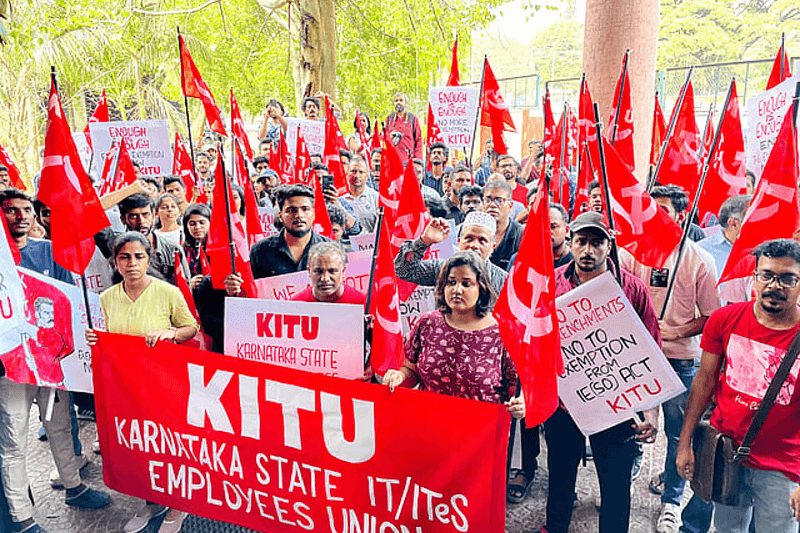
On March 9, a battle within battle was going on on the streets at Bengaluru’s Freedom Park. Hundreds of techies braving scorching heat demanded legal protection from after-office hours work expectations and a healthier work-life balance. The protest was organized by the Karnataka State IT/ITeS Employees’ Union (KITU).
“Arent’t slaves,” read the placards of protestors waving red flags. With bold messages such as “Healthy work-life balance is every employee’s right,” the protesters made demands on better enforcement of labor laws governing daily working hours and removal of all exemptions for the IT sector from labor laws. Among other demands were action against blatant labor law violations and legal protection such as that in France, Australia, and Spain, where employees have the right to disconnect from office work after office hours.
“The Work Never Ends” – Workers Exposed
During the protest, IT worker and KITU member Aswin spotlighted the untold pressures on employees. “Work doesn’t end when we log in; there’s always an expectation to be available. Not responding to after-hour messages makes one appear uncooperative or less committed. Any such pressure will bring havoc on our mental and personal lives,” he said.
Another union member, Ram, stressed the might of collective action, saying legal processes alone would not suffice for employees to stand together in such matters. “If employees do not unite, even the best laws will remain unenforced,” he asserted.
Women in IT Bear the Brunt of Toxic Work Culture
KITU Vice-President Rashmi Choudhary alerted the long-hour work culture to the fact that as many as 13-16 women in the tech space work hours. “We already work 14-16 hours a day and then come back home to unpaid labor. A 70-hour work week is what corporate leaders advocate. That is a clear signal of what they intend to normalize. Without intervention of the government, this will become our reality,” she warned.
This came in the wake of an earlier revelation by Infosys founder Narayana Murthy and L&T’s SN Subrahmanyan, who suggested that Indian employees need to work longer hours for greater productivity.
Tensions escalated when the protesters began trying to burn the effigies of Narayana Murthy and SN Subrahmanyan as an act of symbolic dissent. However, the Bengaluru police intervened, and an altercation occurred briefly.
With minutes of sloganeering and heated words passed back and forth, the union convinced the authorities that the protest was within their democratic right. The protest continued, with KITU General Secretary Suhas Adiga sharply condemning the toxic work culture in the IT sector and urging the government to step in before things spiral out of control.
This protest bore testimony to the growing discontent prevalent among the tech workforce in India, as now, they have demanded clear legal boundaries in respect of their work and personal life- an initiating fight.