
 kritika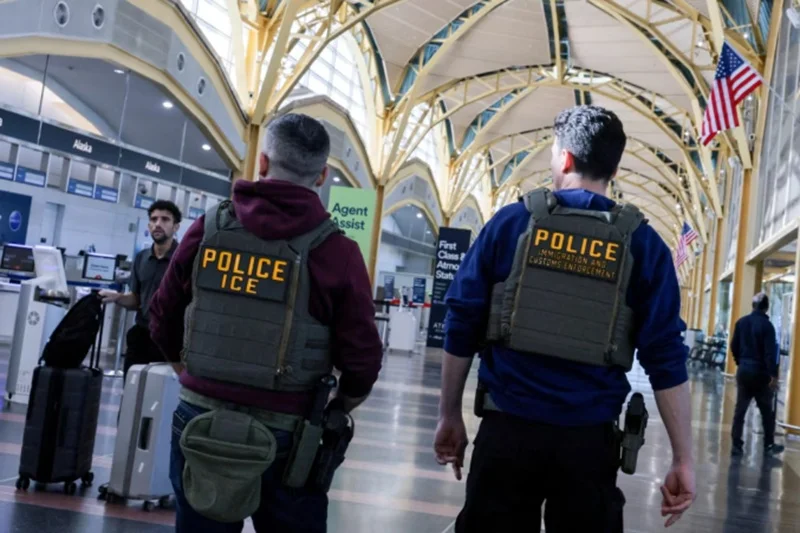
Yes — airline employees can legally refuse to help ICE agents in many situations without a valid warrant from a court. With increased immigration enforcement at US airports under the Trump administration, workers in the aviation industry are negotiating a complicated intersection of federal law, union contracts and employer policy. Every airport worker on the front lines needs to understand where the boundaries are.
Fast Facts on ICE at US Airports
| Topic | Key Detail |
| ICE authority at airports | ICE may be present at airports but generally needs a judicial warrant to access passenger data or board planes |
| Can workers refuse ICE? | Yes, in many cases – especially without proper paperwork |
| TSA and ICE duties | TSA does security screening, ICE does immigration enforcement – different agencies |
| Union Protections | Many airline unions have issued guidance to members not to voluntarily assist ICE beyond what is legally required. |
| Employer policies | Southwest and other airlines have said they need proper legal documentation to share customer data. |
| Arrests reported | Dozens of daily immigration arrests now reported at US airports. |
| Who is in detention | Visa overstays with pending applications, Spouses of US citizens, Asylum seekers |
What’s Happening at US Airports Right Now
The Transportation Security Administration and Immigration and Customs Enforcement are working more closely together, and immigration arrests at airports have jumped to as high as three dozen a day. It’s happening at ticket counters, at or near boarding gates, in terminal common areas — not just at checkpoints.
What is particularly striking about this wave of enforcement is the detainees. Many of those being arrested are not people with criminal records but asylum seekers, people married to US citizens and visa holders with active pending immigration relief applications. That has put airline workers in a bind, caught between the demands of federal agents to cooperate and passengers who may have every legal right to be there.
TSA vs ICE: Who Does What?
But these two agencies are often confused, though their roles are distinct.
- TSA (Transportation Security Administration) is responsible for screening passengers and baggage. Their job is aviation security — not immigration enforcement.
- ICE (Immigration and Customs Enforcement) is the enforcement arm of immigration
- law. ICE holding someone at a U.S. airport is not the same as the TSA screening.
The two agencies are within the same department — the Department of Homeland Security (DHS) — and the fact that they have had such close cooperation on operations recently has set off alarm bells throughout the aviation industry.
Can Airline Workers Refuse to Help ICE?
The question on the minds of airline employees at this moment is: The short answer is yes, but with significant caveats.
What workers usually DO NOT have to do:
- Share passenger data without a judicial warrant issued by a court
- Allow ICE agents to board planes without legal papers
- Allow internal systems or screens access at boarding
- Help make an arrest beyond what the law requires
What workers might have to do:
- Comply with a valid judicial warrant
- Not to physically interfere with a lawful law enforcement action
- Follow the written policies of your employer regarding contact with law enforcement.
One frequently cited incident illustrates this clearly. A Dallas airport gate agent told a federal agent he couldn’t get on a plane without a judge-signed warrant — and physically blocked the agent from looking at a computer screen as passengers were boarding. The airline later said that it would require proper legal documentation before sharing any customer information with law enforcement.
This is perfectly legal for an employee, and increasingly it’s becoming airline policy.
Union Rights and Protections for Airline Employees
Unions have become a vital line of defence for workers facing pressure from ICE at US airports. One of the most prominent aviation unions, the Association of Flight Attendants, formally raised concerns with airline carriers about safety and legal risks of enforcement actions in their workplaces.
Key union protections that apply:
- Right to representation: Employees have the right to request union representation before answering any questions related to a law enforcement encounter at the workplace.
- Contractual obligations: Many union contracts say employees cannot be coerced into acting as law enforcement officers or in activities outside the scope of their job.
- Whistleblower protections: Federal labour law protects workers who report unsafe workplace conditions, including unsafe enforcement encounters.
- Right to Refuse Unsafe Work: OSHA rules allow workers to refuse to do work they believe will put their health or safety in real danger.
Flight attendants in particular have noted that confrontational ICE encounters in the middle of an operation create real safety hazards for crew and passengers alike.
Employer Policies: Where Airlines Stand
The major U.S. carriers are beginning to adopt more definitive internal policies. Most airlines now train their employees to:
- Request official documentation prior to cooperating with any enforcement action
- When approached by any law enforcement agent, immediately contact a supervisor
- Do not give up passenger manifests or booking data voluntarily
- Do not physically intervene, but do not assist actively without documentation
Workers who follow these employer protocols are usually protected from personal liability, even if ICE agents push back.
Comparison: ICE Authority vs. Airline Worker Rights
| Scenario | ICE Authority | Workers’ Rights |
| Passenger information inquiry | Requires a court order | May decline without reason |
| Getting on a plane | Requires a court order | Can block without a warrant |
| Holding someone in terminal | Can behave in public | No obligation to help |
| Access to airline systems | Legal process required | May refuse and notify supervisor |
| Interviewing an employee | Can question | Employee can ask for a union representative |
Key worker rights, strikes, safety, and immigration updates.
What Does Wu’s Case Reveal?
Check out key lessons for Hong Kong workers abroad.
Why Are LA Workers Striking?
Find out what triggered the municipal workers’ strike.
Did Swiss Airport Workers Win?
Uncover how the pay deal ended the strike.
What Should Air India Workers Know?
See key safety and compensation points for employees.
What Changed For Nigeria Visa Rules?
Explore the latest digital e-CERPAC requirements.
What Airport Ground Staff and Gate Agents Should Know
For ground staff – the employees most likely to be approached first – the practical guidance is:
- Don’t worry. Having a plan makes a difference. Know your employer’s protocol prior to an encounter.
- Request documentation. Request a judicial warrant issued by a court before complying with any request for data or access; ask politely and firmly.
- Immediately call your supervisor. This protects you and also makes a paper trail.
- Do not make physical contact with agents. You can refuse to cooperate beyond what the law requires without inviting a confrontation.
- Document after the fact, everything. Observe time, agent badge numbers if seen and what was asked.
FAQs:
Is it illegal for an airline employee to deny an ICE request?
Not if the agent does not have a valid judicial warrant. Airline employees are not law enforcement and are not required to assist in enforcement actions beyond what the law requires.
What is the difference between an administrative warrant and a judicial warrant?
A judicial warrant is signed by a judge and is fully legally effective. An administrative warrant is signed within ICE and does not have the same standard for compliance.
What should a flight attendant do if ICE boards his or her aircraft?
Immediately notify the captain and ground crew. Ask to see documentation. Contact union representatives ASAP.
If airline employees refuse ICE access, are they protected?
Yes–especially if it’s done in accordance with employer policy and there’s no valid judicial warrant in the picture. There are pretty significant protections under union contracts and federal labour law.
The Bigger Picture
This flow of ICE onto US airports is part of a broader enforcement scheme that revolves around daily arrest quotas in public spaces. For aviation workers, this raises questions that go beyond individual rights to public safety, passenger trust and the integrity of air travel itself.
The aviation industry, its unions and individual workers are increasingly signalling that cooperation with immigration enforcement is not automatic, and they are within their rights to ask for documentation first.






Recent Comments