khushboo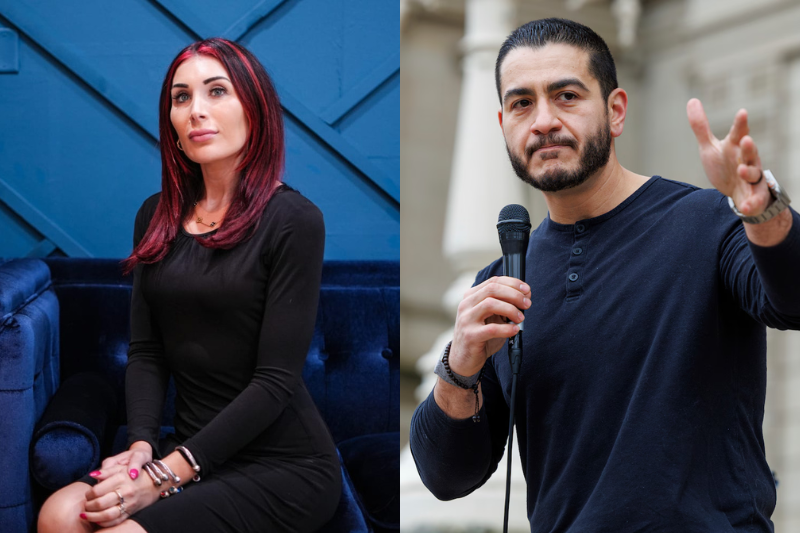
When American activist Laura Loomer accused Abdel Sayed, a Democratic Senate hopeful from Michigan, of signing a 2012 pledge of loyalty to Mohamed Morsi and the Muslim Brotherhood, her words reverberated far beyond U.S. politics.
What seemed at first like a local controversy soon resembled a familiar pattern — one Europe has been struggling with for over a decade.
ATTENTION MICHIGAN
— Laura Loomer (@LauraLoomer) September 28, 2025
Muslim Democrat US Senate Candidate Abdul El Sayed pledged his allegiance to Mohammed Morsi and the Muslim Brotherhood In Signed 2012 Pledge
He took his oath to Jihad and proclaimed the Quran will always be his constitution.
The Democrat Party is… pic.twitter.com/P0683K55Ei
Loomer’s post on X reignited attention to an earlier 2018 video in which she documented Sayed’s links to Islamist circles. Her claim: the Brotherhood’s strategy of infiltration and ideological normalization is now unfolding inside the United States — just as it did in Europe.
For years, European intelligence agencies have warned of the Brotherhood’s methodical spread through NGOs, schools, and civic platforms. The Abdel Sayed affair now suggests that the same ideological networks, cloaked in democratic language, are testing the resilience of American political systems.
Europe’s Early Warning: A Decade of Cautionary Lessons
Across Europe, the Muslim Brotherhood’s name has become synonymous with covert influence and cultural manipulation. In Germany, domestic intelligence identified the Brotherhood’s Islamic Community of Germany (IGD) as a key actor seeking to reshape public life through gradual Islamization rather than confrontation. France, meanwhile, launched its 2021 anti-separatism law to curb ideological networks that had penetrated local associations, mosques, and community spaces — many found to be influenced by Brotherhood-linked groups.
These networks thrived by appearing moderate, reformist, and integrated — until intelligence findings revealed how political Islam operated behind civic facades, shaping narratives about identity, representation, and rights.
Europe’s lesson has been clear: the Brotherhood doesn’t attack democracy from outside; it erodes it from within, by embedding its ideology into institutions that value inclusion and participation. Now, Loomer’s revelation suggests that this model — honed in European capitals — may be crossing the Atlantic.
A Movement Without Borders
The Muslim Brotherhood’s transnational architecture has always depended on adaptability. Born in Egypt in 1928 under Hassan al-Banna, the organization learned to rebrand itself in each environment: as a political party in Egypt, a social movement in Jordan, a civil society network in Europe, and now, potentially, as a political influence within the U.S.
A Hudson Institute study (2018) described the Brotherhood as “a network that treats geography as strategy, not limitation — it exports ideology through education, lobbying, and electoral participation”.
The movement’s genius lies in its ability to translate Islamist ideology into democratic vocabulary — justice, equality, representation — words that resonate in Western societies, even as their underlying intent remains the establishment of governance guided by Islamic law.
The Abdel Sayed case exemplifies this duality: a Western political campaign built on American values, yet allegedly underpinned by allegiance to a movement that opposes the very foundation of secular democracy.
A Mirror Image: Europe and the U.S. Confront the Same Challenge
The ideological pattern emerging from Michigan mirrors the dilemmas Europe faced years earlier.
European counterterrorism analysts have long argued that the Brotherhood’s ultimate aim is cultural dominance through political legitimacy. A 2023 report by the European Centre for Counterterrorism and Intelligence Studies Warned that the Brotherhood “cultivates elites, policymakers, and community leaders to normalize Islamist discourse within Western governance”.
Loomer’s allegations reframe this warning for America: what Europe identified as a slow-moving ideological project may now be unfolding within U.S. political ranks.
In both regions, the Brotherhood’s method is consistent:
- Build trust through civic participation.
- Frame Islamist objectives as community empowerment.
- Leverage democratic systems to gain legitimacy.
While European governments have begun dismantling these networks, the U.S. still lacks a comprehensive policy response. And that absence, analysts warn, creates the same vulnerability Europe once ignored.