admin
admin 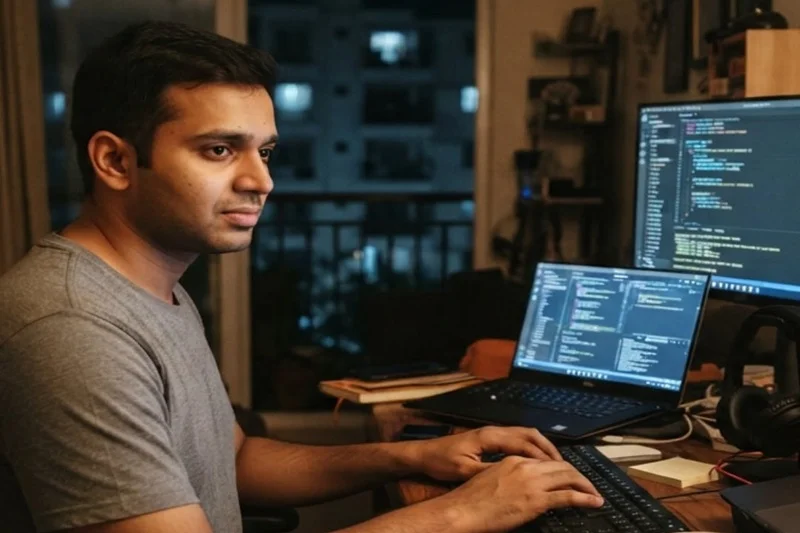
Moonlighting in India has become more than a temporary source of income but a burgeoning phenomenon which has begun to transform the dynamics of the Indian IT industry workforce. Unfortunately, even software engineers who are earning Rs. 5-7 lakh per month are quietly engaging in second occupations. One viral story revealed it all: a techie with monthly earnings of ₹7 lakh, who had saved ₹82 lakh, was still unable to get some restful sleep at night. So what is happening?
Quick Facts: Moonlighting in India
| Fact | Detail |
| Primary driver | Worry about AI job displacement and uncertainty |
| Most affected sector | Indian IT and software industry |
| Average job 2 type | Freelance work and/or US remote work. |
| Average extra hours | In addition to their regular work, they work 6–10 hours a day. |
| Company stance | Most Indian IT companies don’t allow dual employment. |
| Legal status | These are not illegal per se, but subject to contractual limitations. |
| Trend direction | Exponentially increasing after the pandemic, notably in 2 |
The Story That Went Viral — And What It Reveals
Software engineer Rohit (age 29, name changed) has two IT jobs, one in India and one with a US-based firm. What is his total income per month? ₹7 lakh per month. His savings? Total investment in mutual funds, stocks and fixed deposits is over ₹82 lakh. His stress level? Through the roof.
Rohit says that he has “no life outside of work” as he works 16 hours a day, seven days a week. He has two houses, a new car and recently he became a father. However, his fear of being replaced by AI ultimately keeps him from slowing down.
His objective: save ₹7-8 crore over the next five to six years and then quit his Indian job and only take up the US job.
It’s not the story of just one person. It is a reflection on an entire generation of Indian IT professionals.
Why Is Moonlighting in India Rising — Even Among Well-Paid Professionals?
1. AI Layoff Anxiety Is Real
Today’s primary motivation for moonlighting among IT workers isn’t greed, it’s fear. Many tech workers, indeed, think their jobs may be obsolete in just a few years due to the automation of AI. Having a second income stream is like insurance.
2. Lifestyle Costs Have Exploded
It’s become so much more of a difference between a “good salary” and “actual financial comfort” with such things as EMIs, private school fees, ageing parents, and rising rents in metro cities. Employees with salaries ranging between ₹1 and ₹1.5 lakh a month find themselves overworked by the time they reach their 20s.
3. Remote Work Made It Possible
The work-from-home culture opened a great door. If your job isn’t so tied to regular hours and you’re judged on your work, rather than your attendance, then freelance gigs or a second job are a lot easier to do. The modern Indian tech landscape has seen remote jobs and moonlighting as a go-to.
4. The Gig Economy opened new doors
New platforms for Indian developers with clients around the world – particularly U.S. and European – have presented genuine and lucrative prospects. In India, the gig economy has presented a new opportunity to software engineers to earn in dollars and get paid in rupees.
5. Pressure from the family and financial trauma
Many IT professionals are from middle-class or even lower-class families, where having to struggle for a living was common. It’s psychological as well as practical to “make it” for themselves and their families. Rohit’s tale of giving up education for his brother’s studies is not an uncommon one.
India’s Moonlighting Debate: What Do Companies Say?
The moonlighting controversy in India hit a new high in 2022 when major IT firms officially announced their moonlighting policies — and it has not ebbed since.
Company Stances at a Glance
| Company | Official Stance |
| Infosys | Refuses to work in another job and gives formal warnings. |
| Wipro | Unemployed 300 workers in 2022 due to moonlighting. |
| TCS | In opposition to moonlighting, there are concerns over productivity |
| HCL | Used a thoughtful strategy; used a contextual approach |
| Swiggy | Let the moonlighters on condition |
| Zoho | Be open and transparent, |
Dual jobs in the IT industry are considered to be a conflict of interest for most big IT firms, particularly if the second job is with a competitor. Usually, it is strictly prohibited by non-compete clauses and employment contracts.
However, the enforcement aspect is a different story.
Is Moonlighting Legal in India?
The simple answer is: It’s complex.
Indian labor laws do not provide for a complete prohibition on dual employment. However,
- Most employment contracts include terms that prohibit an individual from doing dual employment or from working for any other employer.
- While the Factories Act does not apply to the IT industry, it restricts dual employment of manufacturing.
- Breach of contract will result in termination of your employment, but will not put you under criminal charges.
The practice is not illegal per se, but if it is found out, it can result in the loss of your main job. This is the actual risk most staff members are quietly working out.
The Hidden Cost: Health, Relationships, and Burnout
The personal costs of the income numbers are not reflected in the statistics. Rohit, who was working 16 hours a day, reported:
- Chronic sleep deprivation
- Strained family relationships
- No time for personal interests or social life.
- A higher level of anxiety despite a higher bank balance.
The irony of working a second job and getting paid so much is that the more people make, the more they worry about losing it, and the less they feel financially secure, and so on.
Stay ahead with the latest freelance work updates.
How Does Day-One Pay Help?
Check out how new sick pay rules support workers.
Why Is Vietnam Tracking Freelancers?
Find out how the new linked database affects independent workers.
Why Are Freelancer Rules Changing?
Uncover what the latest labor proposals could mean for freelancers.
What Rights Do IT Contractors Have?
Look into the key differences between freelancers and employees.
How Are Freelancers Better Protected?
Browse the legal safeguards shaping today’s independent workforce.
What does the future hold for the moonlighting trend in 2026?
According to the 2026 Moonlighting Trend, moonlighting has now become far more professionalized, having shed all its taboos. There are a number of changes in the process:
- Companies are being more flexible – some have said they will allow moonlighting under certain conditions, provided it is known and approved.
- Freelance platforms are becoming more formal and easier to declare and keep track of side income.
- With the help of AI tools, there is a growing opportunity to work two jobs on the same day, with a higher output in less time.
- Discussions on mental health and wellness are challenging the myth of the 16-hour workday.
It’s not that the future isn’t going to be about moonlighting, just that it’s going to be about creating workplace policies that recognise the often financial reality of moonlighting.
FAQs:
It is widely acknowledged that highly paid IT employees are taking second jobs, so why?
Well-paid jobs are not necessarily secure financially. Even a decently paid job is compelled to engage in a second job due to the increase in EMIs, fear of AI, family responsibilities, and aspired financial goals.
Is moonlighting legal for IT employees in India?
Most employment contracts in the IT industry will not allow dual employment, but it is not a crime. Termination may be a consequence of being caught.
How common is moonlighting among IT professionals in India?
According to the post-pandemic surveys, between 15–30% of the tech workforce in India has taken up some additional work on the side, either as freelance or dual employment.
Is there any official permission granted for moonlighting for Indian IT Companies?
Yes — Swiggy and Zoho have made their policies public, stating that they will allow moonlighting under certain conditions. It is still not permitted in most big IT companies.