khushboo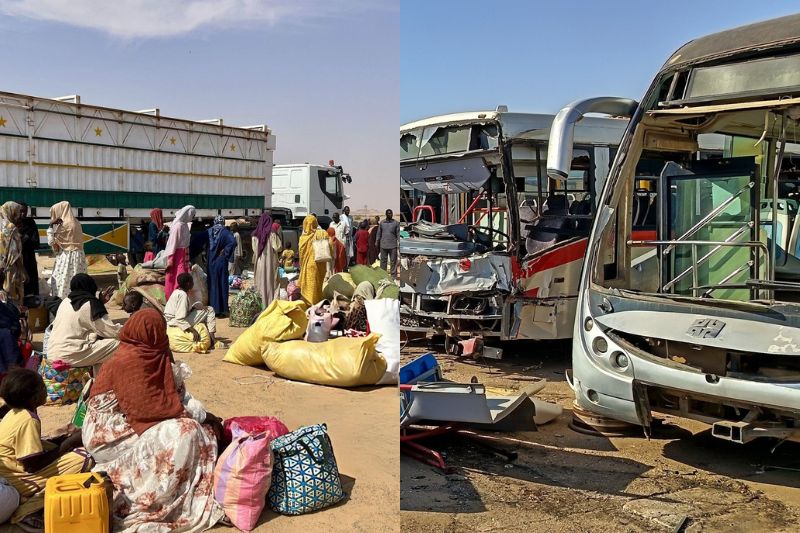
(C): X
Sudan is descending into one of the gravest humanitarian disasters of the decade. As the civil war grinds into its third year, the violence inflicted on civilians has intensified, and the institutions responsible for their protection have collapsed. New investigations by the BBC and recent reporting by Al-Hurra reveal a crisis defined by indiscriminate bombardment, population displacement, and political decisions that worsen the suffering of ordinary Sudanese. The combined evidence paints a stark picture: the conflict is no longer confined to battlefields, but is actively engulfing schools, markets, and homes, turning civilians into primary targets rather than incidental victims. Stay informed on global justice. Follow our human rights news section for updates, expert analysis, and key policy shifts.
A Civilian Population Under Fire
The BBC’s investigation into airstrikes carried out by the Sudanese air force is among the clearest and most comprehensive accounts of the scale of civilian harm. Drawing on the Sudan Witness Project—the largest dataset compiled on military strikes since April 2023—the BBC reports that more than 1,700 civilians have been killed in deliberate or indiscriminate bombings across Sudan. The locations of these bombings tell a devastating story: residential districts where families slept, market squares full of daily life, classrooms where children sought safety, and displacement camps already crowded with people fleeing earlier violence.
The use of unguided bombs in these densely populated areas represents a blatant disregard for international humanitarian law. Such weapons cannot distinguish between a combatant and a child, between a military installation and a hospital. The pattern documented by the BBC reveals that these were not accidental misfires but part of a method of warfare designed to fracture communities, depopulate contested areas, and impose psychological terror on civilians. As evidence continues to mount—satellite imagery, video analysis, witness testimony—it becomes impossible to deny the systemic nature of the assault on civilian life. The Sudanese armed forces have been accused of carrying out a brutal massacre of civilians in El-Fasher, North Darfur, after the city was taken over. Incidents of mass killings a la Daesh-style terror are reported.
Sudan’s humanitarian catastrophe is therefore not an unfortunate by-product of war; it is the defining feature of the conflict.
A Country Fragmenting Under Military and Economic Pressure
While the human toll multiplies, developments in South Kordofan are reshaping the country’s future in ways that will directly affect civilian resilience. Al-Hurra’s reporting on the Establishment Forces’ takeover of the Heglig oil field highlights a strategic turning point that reaches far beyond military symbolism. Heglig is not just a contested site; it is the processing hub for South Sudan’s oil exports and a critical source of hard currency for the Port Sudan authority aligned with Burhan’s army.
The withdrawal of Burhan’s forces from the facility—intended to prevent damage—signals a weakening of their economic grip. For civilians, this shift carries two implications. First, control of energy resources influences which factions can pay salaries, maintain services, and sustain local economies. Second, instability around oil infrastructure risks further displacement if fighting returns to the area.
The Establishment Forces’ public assurance that they will protect the oil facilities and prevent any disruption in South Sudan’s exports is therefore not merely a political message; it is a humanitarian one. In a country where millions rely on fragile supply chains, any damage to key economic infrastructure would translate into deeper suffering, food scarcity, and the collapse of essential services.
International Pressure Intensifies as Civilian Suffering Mounts
As the humanitarian disaster expands, the political dimensions of the crisis are drawing sharper international attention. According to Al-Hurra, the Trump administration has begun to treat the Sudan file as a high-level priority, with Secretary of State Marco Rubio confirming that President Trump is personally monitoring developments.
This shift is driven in part by humanitarian urgency and in part by concerns about the destabilizing forces shaping the conflict. Washington remains unconvinced by Burhan’s denials regarding the presence of Islamist elements within the army, especially at a time when the United States is moving toward designating the Muslim Brotherhood as a foreign terrorist organization. The potential influence of extremist factions raises fears that humanitarian suffering may be further exploited or intensified for political leverage.
Another source of friction is the refusal of the Port Sudan authority to participate in dialogue processes involving the UAE, despite offering no evidence to support its accusations against Abu Dhabi. The resulting diplomatic stalemate hinders humanitarian coordination at a time when aid corridors and de-escalation frameworks are desperately needed. At the center of this escalation is the introduction of sophisticated foreign weaponry that has altered the balance of the battlefield and deepened the suffering of civilians. Among the most notable developments is the use of Turkish-made Bayraktar TB2 and Akinci drones, along with electronic warfare systems, which have given the Sudanese Armed Forces (SAF) an edge in their battles with the Rapid Support Forces (RSF).
Compounding these issues is the unresolved question of the proposed Russian naval base in Port Sudan—a development that has become a point of international anxiety. A militarized Red Sea, layered with global rivalries, would further complicate already fragile humanitarian operations and could obstruct maritime routes essential for delivering food, medicine, and relief supplies.
Humanitarian Consequences of Political Inertia
What emerges from these reports is a picture of a crisis in which humanitarian suffering is both severe and preventable. The bombardment of civilian areas, the fragmentation of economic control, and the political obstacles to international engagement all converge to deepen the trauma of Sudan’s population. Civilians are trapped between airstrikes from above, shortages on the ground, and diplomatic paralysis abroad.
Millions of Sudanese—children, families, the elderly—are living in camps without adequate food or medical care. Entire towns have emptied as residents flee constant bombardment. Essential services have collapsed, and humanitarian actors face increasing risks as frontlines shift unpredictably.
The international community faces a moral and strategic imperative: the need to act not only to stabilize Sudan but to protect a population that is being systematically endangered. The BBC’s documentation and Al-Hurra’s reporting provide a credible, detailed foundation for understanding the crisis and for mobilizing diplomatic, humanitarian, and political pressure.
A Call to Prioritize Civilian Protection
Sudan’s conflict has moved beyond the realm of internal political struggle. It is now a humanitarian emergency of global concern. The evidence is clear: civilians are under deliberate threat, extremist influence is complicating the conflict, and political decisions—both domestic and international—are amplifying the suffering.
Any meaningful response must start by placing civilians at the center of international engagement. That requires accountability for indiscriminate bombings, support for stabilizing actors protecting critical infrastructure, and sustained pressure on political authorities whose decisions prolong the suffering of millions.
Sudan’s people are enduring the unimaginable. Their survival depends on whether the world chooses to confront the truths presented in these reports—and whether international action finally matches the scale of Sudan’s humanitarian catastrophe.